Search


Water hyacinth can form dense mats due to the species’ rapid growth during the summer [3]. These mats can block sunlight from reaching submerged aquatic vegetation, which often kills these plants [9]. The decaying plant material from this process can decrease the dissolved oxygen content of the water, resulting in fish kills [9]. This coupled with water hyacinth’s tendency to clog waterways, thus inhibiting boat traffic, has earned the plant a reputation as a pest among fishermen and boaters. Major economic impacts caused by invasion of water hyacinth include interference with navigation, irrigation and power generation [3]. Water hyacinth can also provide an excellent breeding ground for disease-transmitting pests, such as mosquitos and schistosomiasis-carrying snails [9].
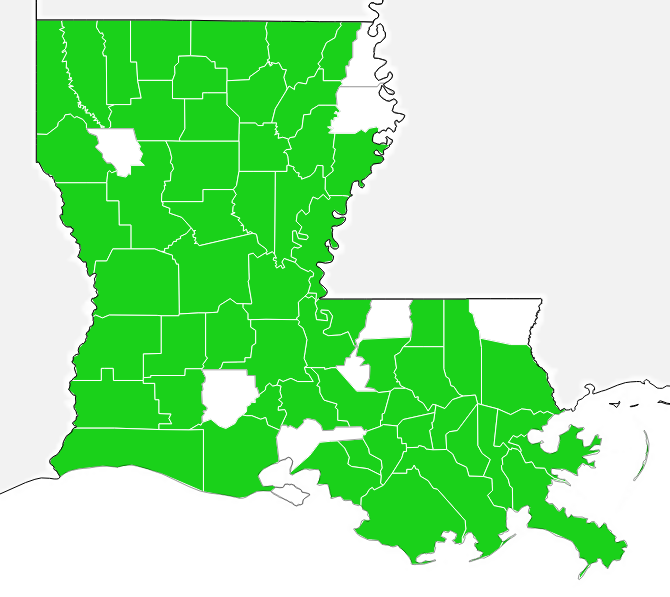

Images courtesy of EDDMapS. EDDMapS. 2018. Early Detection & Distribution Mapping System. The University of Georgia - Center for Invasive Species and Ecosystem Health. Available online at http://www.eddmaps.org/; last accessed August 21, 2018.
While native to South America, water hyacinth is now found in many countries across the world, including Australia, South Africa, and India. The plant’s first introduction to the United States was at the Cotton States Exposition in New Orleans in 1884 [3]. Presently, it inhabits most of the southeastern U.S., California and Hawaii (Figure 4). Despite previous reports, populations of water hyacinth are considered eradicated in Arizona, Arkansas and Washington State [3]. Reports from New York, Kentucky, Tennessee and Missouri, where water hyacinth was intentionally introduced, have not been permanently established due to extreme winter temperatures [3]. This plant is found in many of the bayous, lakes, and other waterbodies of Louisiana. The plant may be more abundant in disturbed waterbodies, like ditches and man-made ponds [3].
First introduced into the US in Louisiana, water hyacinth has become a major problem in the state over the last century. It can quickly spread in manmade waterbodies like ditches or livestock ponds, especially in agricultural areas, where fertilizer runoff can worsen the infestation [9]. The plant has invaded many major bodies of water in Louisiana, such as the Mississippi River and Lake Salvador, and many of our coastal marshes.
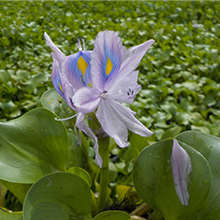
Water hyacinth with lavendar flowers.
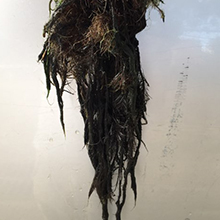
Long, feathery roots of water hyacinth.
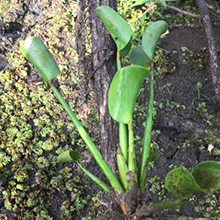
Waxy, cup-shaped leaves of water hyacinth.
Water hyacinth can reproduce both sexually and vegetatively, though the plant primarily spreads through vegetative reproduction [5]. The plant reproduces vegetatively by producing a copy of its self which is attached to the original plant by a stolon, which is a kind of stem (see Figure above). A single water hyacinth plant can infest an area of up to 2,000 square feet in a year. The seeds of this plant can remain viable for up to 20 years [9].Water hyacinth can reproduce both sexually and vegetatively, though the plant primarily spreads through vegetative reproduction [5]. The plant reproduces vegetatively by producing a copy of its self which is attached to the original plant by a stolon, which is a kind of stem (see Figure above). A single water hyacinth plant can infest an area of up to 2,000 square feet in a year. The seeds of this plant can remain viable for up to 20 years [9]. Water hyacinth can be easily recognized by its waxy, cup-shaped leaves, long, feathery roots, and white or lavender flowers [5]. Water hyacinth is sometimes confused with pickerelweed. But pickerelweed, unlike water hyacinth, has flat, pointed leaves.
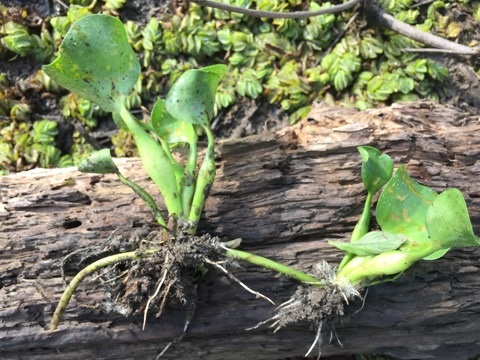

Image courtesy of University of Florida.
Two common methods of controlling water hyacinth are mechanical removal and the use of herbicides [9]. Mechanical methods include shredding or cutting the plants using specially designed boats. The most widely used control option is the application of herbicides, such as 2,4-D and glyphosate.
Authors: Seth Spinner, Allie Cozad, Sebe Brown, and Rodrigo Diaz.
Numbers in brackets are references and can be found on the resources page.